

What is the thrombin shortage right now?
FDA's CBER shortage page, current as of Sept. 28, 2026, says Thrombin-JMI (bovine) is not available. The listing covers 5,000 IU and 20,000 IU vials and kits, gives a September 2026 onset and a reason of "Other," and shows no resolution date. The listing names the six lyophilized NDCs and predates Pfizer's October letter on the liquid, so it should not be read as a statement about the liquid vials.
- Lyophilized Thrombin-JMI, six NDCs: Depleted, with next delivery 06/2027 and estimated recovery 2Q 2027, per Pfizer's Oct. 29 availability report.
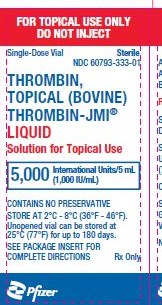
- Thrombin-JMI Liquid 5,000 IU (NDC 60793-0333-01) and 20,000 IU (NDC 60793-0020-01): Supply Available in the same report. Pfizer's Oct. 12 letter says both are at wholesalers and distributors, with inventory varying by location.
- Thrombi-Gel 100 (NDC 60793-0909-10): Depleted on Pfizer's catalog search page, with next delivery 12/2026 on its product page. It does not appear in the Oct. 29 report.
- GEL-FLOW Kit with Thrombin-JMI (NDC 00009-2250-01): Depleted, with next delivery 12/2028 and estimated recovery 4Q 2028 listed against what the report calls the old NDC.
Those dates need careful reading. Pfizer's report defines next delivery as arrival at its distribution center, not the day a buyer will have product, and says full recovery may depend on market dynamics. Its status text describes no current shipments to wholesalers, and on five of the six rows it tells buyers to ask wholesalers about remaining inventory. Some channel stock may therefore exist today, but no public source says how much.
FDA's drug shortage data is a separate check that can mislead here. An openFDA query for thrombin returned no matches on Oct. 30, yet FDA's CBER page carries Thrombin-JMI as not available. A missing listing does not prove normal supply.
PRN has also seen increased requests for Thrombin-JMI this year.
Is Thrombin-JMI discontinued, or just difficult to source?
The public sources reviewed describe depletion, not a market withdrawal. FDA treats Thrombin-JMI as a current shortage, and Pfizer's report still shows delivery and recovery dates for the lyophilized line. There is one loose end: the report's row for the epistaxis kit, NDC 60793-0205-05, points to the report's NDC Change column for an updated NDC and calls the listed number the old NDC, but that column is blank in the Oct. 29 report. The GEL-FLOW row carries the same wording. Buyers of either kit should ask Pfizer whether the NDC is changing.
Recovery dates also appear to have moved. Nuo Therapeutics' 10-Q, filed Aug. 14, 2026, says Pfizer told the company in late June that Thrombin-JMI would be unavailable and that recovery was expected in early 2027. Pfizer's report now shows June 2027. Nuo also says it became aware of supply challenges in Spring 2026, while FDA lists a September 2026 onset. No source reviewed reconciles those dates, so buyers should treat any date as subject to change.
What is causing the Thrombin-JMI shortage?
Neither Pfizer nor FDA has confirmed a cause in the sources reviewed. FDA's stated reason is only "Other," and Pfizer's Oct. 12 letter gives no explanation.
The one public explanation comes from a third party. Nuo, a Pfizer thrombin customer, writes in its 10-Q that it understood the supply challenges to relate to a diluent co-packaged with the lyophilized vial. That is Nuo's understanding, not a confirmed finding. Nuo also states that bovine thrombin is available solely through Pfizer, which is likewise a company statement.
The liquid should not be read as a response to the outage. FDA approved the liquid supplement on April 10, 2026, after receiving it on Dec. 11, 2025, which is before the Spring 2026 awareness Nuo reports. No source describes it that way or ties its availability to any cause.
Which products and presentations are affected?
| Product | NDC | Manufacturer | Status as of Oct. 29, 2026 | Next delivery; estimated recovery |
|---|---|---|---|---|
| Thrombin-JMI 5,000 IU vial with 5 mL diluent | NDC 60793-0215-05 | Pfizer | Depleted | 06/2027; 2Q 2027 |
| Thrombin-JMI 5,000 IU epistaxis kit with nasal drug delivery device and syringe | NDC 60793-0205-05 | Pfizer | Depleted; report calls this the old NDC, and its NDC Change column is blank | 06/2027; 2Q 2027 |
| Thrombin-JMI 5,000 IU syringe spray kit | NDC 60793-0705-05 | Pfizer | Depleted | 06/2027; 2Q 2027 |
| Thrombin-JMI 20,000 IU vial with diluent | NDC 60793-0217-20 | Pfizer | Depleted | 06/2027; 2Q 2027 |
| Thrombin-JMI 20,000 IU pump spray kit | NDC 60793-0217-21 | Pfizer | Depleted | 06/2027; 2Q 2027 |
| Thrombin-JMI 20,000 IU syringe spray kit | NDC 60793-0217-22 | Pfizer | Depleted | 06/2027; 2Q 2027 |
| Thrombin-JMI Liquid 5,000 IU/5 mL vial | NDC 60793-0333-01 | Pfizer | Supply Available; inventory varies by location, per Pfizer's Oct. 12 letter | Not applicable |
| Thrombin-JMI Liquid 20,000 IU/20 mL vial | NDC 60793-0020-01 | Pfizer | Supply Available; inventory varies by location, per Pfizer's Oct. 12 letter | Not applicable |
| Thrombi-Gel 100 with 2,000 IU Thrombin-JMI | NDC 60793-0909-10 | Pfizer | Depleted per Pfizer's catalog search page, read Oct. 30; not in the Oct. 29 report | 12/2026; 4Q 2026, per Pfizer's product page |
| GEL-FLOW Kit with Thrombin-JMI 5,000 IU and diluent | NDC 00009-2250-01 | Pfizer | Depleted; report calls this the old NDC, and its NDC Change column is blank | 12/2028; 4Q 2028 |
Recothrom and Evithrom: no citable status. Neither product appears on FDA's CBER page or in openFDA's shortage data, and Baxter's product updates page has no Recothrom item. No current public source reviewed confirms supply status for either one, in either direction. That absence does not show that supply is normal or that it is short, so buyers should get current status from each manufacturer directly.
How is this affecting healthcare buyers and facilities?
- A longer planning horizon. Pfizer's inbound date for lyophilized vials and kits is June 2027, at least seven months away. No public source says how much wholesaler stock remains, so that stock is not a basis for a plan.
- Item master work. The liquid has its own NDCs and wholesaler item numbers, so order guides built on lyophilized NDCs may not capture it. Pfizer's letter lists those numbers and invites customers to share updated forecasts with their wholesalers. DailyMed shows marketing start dates of June 8, 2026 for the 20,000 IU vial and Aug. 31, 2026 for the 5,000 IU vial.
- Storage and handling changes. The label calls for storage at 2°C to 8°C, allows an unopened vial to be kept at 25°C for up to 180 days, and describes a single-use product with no preservative that needs no reconstitution. It also carries a boxed warning on severe bleeding and thrombosis, which belongs with clinical teams. Refrigerator space, receiving steps, and room-temperature date tracking are the operational consequences.
- Kit and device gaps. Pfizer lists the liquid in vials only, with no liquid kit. The label says a spray may be used and permits aseptic transfer to a sterile container, but it does not name or clear the legacy kit devices. Kit components should not be assumed interchangeable.
- Exposure beyond the main line. Thrombi-Gel and GEL-FLOW carry different dates from the vials and kits. Nuo also reports that its Aurix and private-label products went temporarily out of stock in early August, so facilities using products that depend on thrombin may want to check with those suppliers.
What should facilities do when supply is tight?
- Audit by NDC. List on-hand quantities and usage for each lyophilized vial and kit, plus Thrombi-Gel and GEL-FLOW, then ask your wholesaler about remaining inventory for each one.
- Treat listed dates as Pfizer inbound dates. Build lag into plans after June 2027 and recheck Pfizer's report on a set schedule, since a mid-2026 filing cited an earlier date.
- Set up the liquid before you need it. Add both NDCs to the item master, update order guides, and share forecasts with your wholesaler, as Pfizer's letter invites. Supply Available does not speak to allocation or to stock at a given wholesaler location.
- Check storage and tracking. Confirm cold storage capacity at each location and decide how room-temperature start dates will be recorded.
- Map kit-dependent workflows. Identify where spray and epistaxis kits are used, then send device questions to Pfizer and your surgical and pharmacy leads rather than resolving them at the purchasing desk.
- Get other thrombin status in writing. Ask Baxter and the Evithrom manufacturer for current status before counting either product in a plan.
- Use pharmacy and governance controls. Decisions on substituting any thrombin product or changing a protocol belong to clinical teams and P&T, checked against current labeling.
- Order to a documented forecast. With inventory varying by location, duplicate orders across channels make it harder to see your real position.
Where can buyers monitor supply information through PRN?
Start with the Drug Shortage News hub for market context and the drug shortage index for other shortage categories. High-Demand Products covers adjacent product categories, and the FAQ answers common operational questions. For source status, recheck the Pfizer report and FDA's CBER page.
PRN can help facilities source thrombin presentations by NDC and plan around the gap. Use Request a Custom Quote for a specific NDC. New licensed facilities can start through customer onboarding, and teams that want background on PRN's support model can review Who We Are.
Need help sourcing thrombin by NDC or planning around a kit gap? Use Request a Custom Quote for shortage-related sourcing support, or start customer onboarding if your facility needs a purchasing account.
Important note: This article is intended for general informational and procurement reference only. It is not medical, legal, or regulatory advice. Facilities should confirm current shortage status, labeling, storage, device compatibility, interchangeability, and purchasing decisions through current manufacturer, wholesaler, FDA, pharmacy, and institutional review channels before acting.